 Mauricio Junior

Which technology does Netflix use nowadays?
Do you know that they have more than 190 open p...

I will tell you 6 important topics, plus a job part.
If you were to rebuild Netflix today, you wouldn't just be building a video player; you would be building a global logistics network for bits.
As a developer, looking at Netflix is less about "what framework do they use" and more about "how do they survive failure at scale?"
Here is the technical breakdown of the Netflix stack, organized by the problems they solve.
1. The "Paved Road" (Backend & Microservices)
Netflix popularized the concept of the "Paved Road"—a supported, opinionated set of tools that allows developers to spin up services without reinventing the wheel. If you stay on the road, you get tooling, logging, and alerts for free.
Language: Java is the king here. While they use Python (scripting/data), Node.js (frontend/BFF), and Go (CLI tools), the core heavy-lifting microservices are Java and Spring Boot.
Service Communication:
gRPC / Protobuf: For internal service-to-service communication (highly efficient binary serialization).
GraphQL Federation: They have moved aggressively toward a federated GraphQL architecture for their API layer, aggregating hundreds of backend microservices into a single graph for the frontend to consume.
Orchestration: Netflix Conductor. This is their open-source tool for orchestrating microservices workflows. Instead of services calling each other in a chaotic spiderweb (choreography), Conductor acts as the conductor of an orchestra, managing state and retries for complex flows like "User clicked play" or "Encode this video.
2. The Frontend (Client Side)
The "Netflix" you see is actually a massive A/B testing machine. The stack is designed to swap out UI components dynamically based on user tests.
Web: React.js. They famously moved away from their legacy stack to a modern React architecture.
Node.js: used heavily for the "Backend for Frontend" (BFF) pattern. The Netflix server running in the cloud that talks to your TV isn't a generic API; it's often a Node script specifically optimizing the payload for your specific device (e.g., a PS5 gets a different data structure than an iPhone).
Mobile: Native Swift (iOS) and Kotlin (Android). They do not use React Native for their core playback experience; performance is too critical.
3. The Data Layer (Where the scale hits)
Netflix does not have a single "master database." They use a polyglot persistence model.
Cassandra (The Heavy Lifter): This is their primary data store for user history, viewing progress, and metadata. Why? Because Cassandra writes fast and scales linearly. If a region goes down (e.g., AWS us-east-1), Cassandra replicates data to other regions, so you don't stop streaming.
EVCache: A custom wrapper around Memcached (and RocksDB). This handles the massive read load. When you open Netflix, you are hitting this cache, not the database.
CockroachDB: They have been adopting this for workloads requiring strong consistency (ACID transactions) across regions, something Cassandra struggles with.
4. Infrastructure & "The Cloud"
Netflix is "all-in" on AWS, but they don't just use EC2; they build platforms on top of it.
Titus: Their internal container management platform (similar to Kubernetes, but built before K8s was mature). It schedules containers on AWS EC2 instances, handling massive batch jobs (like video encoding) and service workloads mixed together to save money.
Spinnaker: Their Continuous Delivery (CD) platform. It allows them to deploy thousands of times a day with safety features like "Canary Deployments" (rolling out code to 1% of users to check for errors before going to 100%).
Chaos Monkey / Simian Army: The famous tool that randomly kills servers in production. This forces developers to write code that assumes the server will crash.
5. Content Delivery (The Secret Sauce)
This is the only part that isn't on AWS. AWS is too expensive and slow for streaming 4K video to 250 million people.
Open Connect: This is Netflix's proprietary CDN (Content Delivery Network).
Hardware: They build their own physical red server boxes (OCAs - Open Connect Appliances).
Software: FreeBSD and NGINX. They use FreeBSD because they can tweak the kernel for extreme network throughput.
Location: These boxes are physically installed inside your ISP's data center (e.g., Comcast, AT&T). When you hit "Play," the video comes from a box down the street, not from an AWS server in Virginia. +1
6. Data & Analytics
How do they know you like "80s Sci-Fi Horror"?
Apache Kafka: The nervous system. Every click, pause, and scroll is an event sent to Kafka.
Apache Flink: For real-time stream processing. It calculates things like "Trending Now" instantly.
Apache Iceberg: A table format for huge analytic datasets, stored on Amazon S3.
Jobs
- More than 191 open positions
- Start with: https://jobs.netflix.com
- https://jobs.netflix.com/careers/engineering
- Software engineer: https://explore.jobs.netflix.net/careers?pid=790314312724
Invest in your career using plataforma.academy.
I how you like it and see you soon.
Related articles
HTML, CSS and JavaScript classes for free
Here you can see many classes with 1 minute

Nuget Packages from Mauricio Junior
See about it with more details
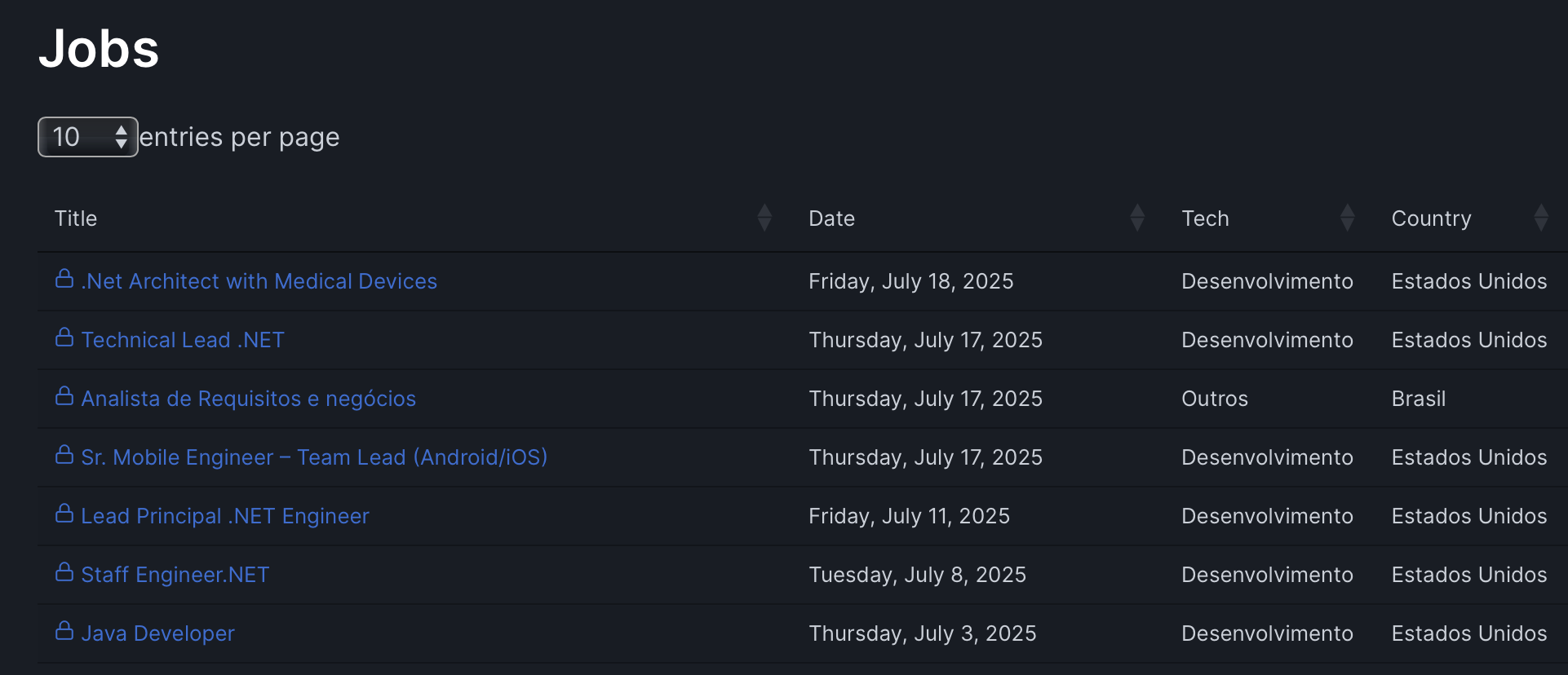
Vagas disponíveis na área de tecnologia
Quer analisar a quantidade e disponibilidade?

Cientistas encontram PROVA de uma fórmula para a felicidade: Encontre alegria nas pequenas coisas
Veja mais detalhes para ser encontrar a fórmula


